
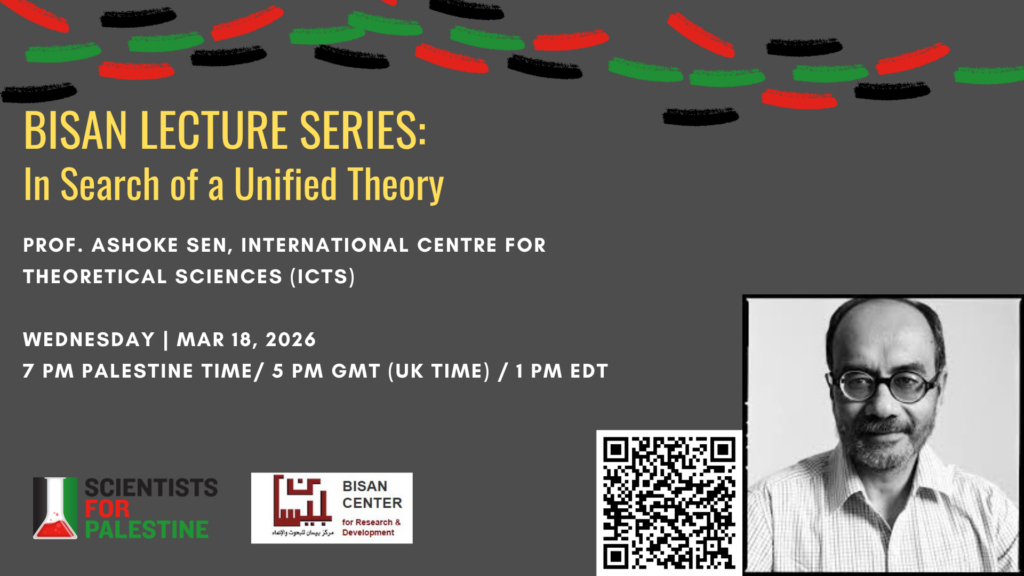
Wednesday, March 18, 2025, 7 pm Palestine time
Prof. Ashoke Sen, International Centre for Theoretical Sciences (ICTS)
Title: In Search of a Unified Theory
Abstract: One of the questions that humans have asked almost since the beginning of civilization is: what are we made of and what are the laws that these basic constituents of matter obey? Theoretical and experimental efforts during the last century and this century have given us a partial answer to this question, leading to what we call today the `Standard Model’. In this model, all matter is made of different combinations of a finite number of tiny particles, called the elementary particles. In the first part of the talk I shall review these developments.
However, the standard model does not explain one important force in nature, namely the gravitational force. In current experiments, the effect of gravitational force between the elementary constituents of matter is extremely small. This explains why the standard model has been so successful in explaining the properties of the elementary particles. However, without including the effect of gravity, our understanding of the natural laws is not complete. In the second part of the talk I shall describe our attempt to include gravity in this framework using string theory. This is a radical framework in which the elementary constituents of matter are taken to be tiny strings instead of point-like particles. I shall discuss what string theory has achieved and what still remains to be achieved.
Bio: Ashoke Sen is a theoretical physicist and ICTS-Infosys Madhava Chair Professor at the International Centre for Theoretical Sciences (ICTS), Bangalore. A former Distinguished Professor at the Harish-Chandra Research Institute, Prayagraj, he has also been an honorary fellow of the National Institute of Science Education and Research (NISER) India, a Morningstar Visiting Professor at the Massachusetts Institute of Technology (MIT) and a Distinguished Professor at the Korea Institute for Advanced Study. He was among the first recipients of the Breakthrough Prize in Fundamental Physics “for opening the path to the realization that all string theories are different limits of the same underlying theory”. He was also awarded a Dirac Medal for “crucial contributions to the origin, development and further understanding of string theory.